Muhid Hassan Risvy

Muhid Hassan Risvy

Ph.D. student in computer science, New Jersey Institute of Technology

I study how older adults decide whether to trust technologies designed for aging, and what that should change about how we build AI.

Muhid Hassan Risvy

About

I'm a Ph.D. student in computer science at the New Jersey Institute of Technology, working on human-computer interaction and human-AI collaboration. Most of my current work asks how older adults decide whether to trust technologies designed for aging, and what that means for building AI systems people can understand and question.

Before NJIT, I did my B.Sc. in computer science and engineering at Shahjalal University of Science and Technology (SUST) in Bangladesh, where I worked on usable security and blockchain systems.

At NJIT I have also taught as a teaching assistant, in courses ranging from introductory cybersecurity to human-robot interaction. See Experience.

Research

How older adults decide whether to trust the technologies designed for them.

For my first paper, my coauthors and I reviewed empirical studies in which older adults talked about trusting, and not trusting, technology. Three patterns kept returning.

  1. Legibility

    Distrust emerges when the workings of a system become illegible: when a person cannot tell where their information is stored, or trace where it moves.

  2. Time

    Trust is not settled once. It builds through prior experience and shifts with breakdowns, so the same person can rely on a system in one phase of use and withhold that reliance in the next.

  3. Boundaries

    Distrust can also be deliberate boundary work: a way of limiting how far a technology reaches into a person's autonomy, relationships, and everyday life.

These patterns point toward systems that support trust across the phases of use, and that make the movement and persistence of information perceptible rather than hidden.

Towards Designing for (Dis)Trust in Technologies for Aging

Muhid Hassan Risvy, Dimitri Theodoratos, Alisha Pradhan

Proceedings of the 28th International ACM SIGACCESS Conference on Computers and Accessibility (ASSETS 2026). Accepted.

arXiv preprint

Across cohorts of older adults and generations of technology, (dis)trust has continued to shape the acceptance of technologies for aging. Yet, we still know little about if or how to design for older adults' distrust in technology. Towards this, we reviewed empirical studies in which older adults discussed trust and distrust in relation to technology. Our analysis shows that (dis)trust is constituted in three key ways: it emerges when material arrangements of digital systems become illegible, such as when older adults cannot determine where information is stored or trace its movement; it is temporally constituted and fluid, building and shifting through prior experience and breakdowns; and at times distrust can operate as boundary work through which individuals limit technology's reach into their autonomy, relationships, and everyday lives. Our work yields design directions for supporting trust across different phases of technology use and by designing systems that make the movement and persistence of information more perceptible.

@inproceedings{risvy2026distrust,
  author    = {Risvy, Muhid Hassan and Theodoratos, Dimitri and Pradhan, Alisha},
  title     = {Towards Designing for (Dis)Trust in Technologies for Aging},
  booktitle = {Proceedings of the 28th International ACM SIGACCESS Conference on Computers and Accessibility (ASSETS '26)},
  year      = {2026},
  publisher = {ACM},
  doi       = {10.1145/3797867.3829057}
}

I work mainly with qualitative and mixed methods, and I try to turn what I learn into concrete design guidance for systems that are more transparent and more accessible. Beyond this paper, I am interested in what appropriate reliance on AI should look like for people who are not experts in it. See Publications for the full list.

News

  1. Our paper “Towards Designing for (Dis)Trust in Technologies for Aging” was accepted to ACM ASSETS 2026 in Porto, Portugal. arXiv preprint.

  2. Appointed as a graduate research assistant at NJIT.

  3. Elected as a vice president of the Bangladeshi Graduate Student Association at NJIT.

  4. Started the Ph.D. program in computer science at NJIT.

  5. Graduated with a B.Sc. in computer science and engineering from SUST.

Recognition

  • Finalist, Blockchain Olympiad Bangladesh 2021 and 2022
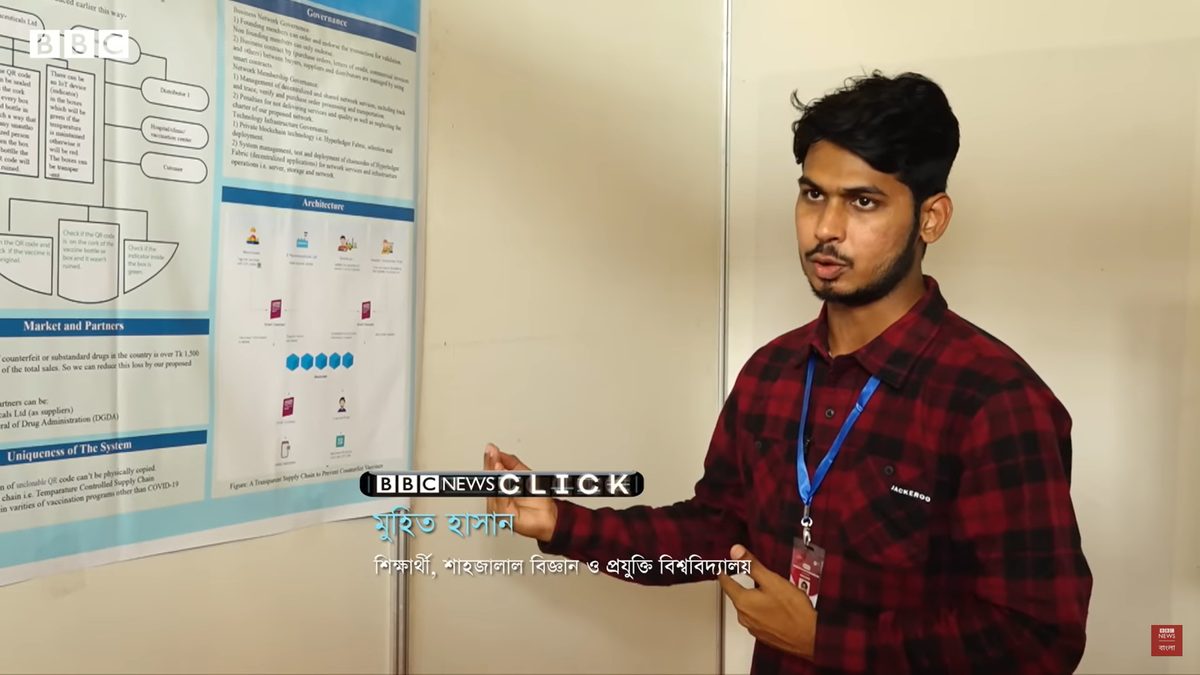
Muhid Hassan Risvy presenting the vaccine supply chain poster in a BBC News Click Bangla segment
Presenting our vaccine supply chain project, featured by BBC News Click Bangla, June 2022. Coverage in The Business Standard.

Membership and service

  • Vice President, Bangladeshi Graduate Student Association at NJIT Current, since April 2026
  • Member, Association for Computing Machinery since July 2026
  • Treasurer, Bangladeshi Graduate Student Association at NJIT May 2025 – April 2026

Contact

mr2229@njit.edu

New Jersey Institute of Technology
218 Central Ave, Newark, NJ 07102

It is daytime in Newark right now.

GitHub LinkedIn CV (PDF)